Paul, here is the ride service I have worked through.

A ride to church.
A way home.

A simple way to help our seniors join us on Sundays, with regular arrangements that keep working — and someone to help when plans change.

Prepared by Christian

Illustrated walkthrough · fictional examples · no real bookings here

Sunday, 18 OctoberTwo journeys. One clear plan.
9:41
cbcMy ridesML

Good morning, Marie

Your Sunday is arranged.

MLJLMarie + Jean
2 people travelling together
To church

Samuel · pickup at 9:00 am

Meet at your front gate
✓
Back home

Clara · around 12:00 pm

Meet by the church entrance
✓

These arrangements continue.
No weekly form to fill in.

Report a changeCall coordinator

Not another thing to do every week.
Just a dependable arrangement.

Register once.
Ask for rides or offer help.

Agree the arrangement.
People, places, times and both journeys.

Only report changes.
A normal Sunday needs no new form.

Try a Sunday together

The plan stays simple.
Even when life happens.

Explore the fictional examples, or press Play for a short guided tour. Nothing here makes a booking or sends a message.

About 75 seconds · captions, no sound
1 of 6
1

Set it up once.

Marie and Jean need a ride. The church office can register them once, agree the details with the drivers, and keep them informed by phone. They do not need an app or a WhatsApp account.

cbc

Sunday ride plan

18 October · example
A regular arrangement

Everyone knows the plan.

Interactive illustration only. Examples reset when you change scenario.

The following Sunday keeps its usual plan. A change for one date does not rewrite the ongoing arrangement.

From first request to home again

A human service,
with a shared plan.

CBC helps people keep the details together. The coordinator, drivers and personal contact make the service work.

The ride journey: register once, agree a regular ride, travel to church, meet for the return journey, and confirm everyone has a way home.

One simple registration

A senior, relative or the church office can make the first request. We record the people travelling, contact person, pickup details, journeys needed and practical assistance.

Drivers can offer a regular arrangement, or simply say: “Ask me when help is needed.” Standby drivers can leave the date and number of seats open.
A real agreement

The coordinator checks the route, timing, suitable vehicle and seats. A companion counts as a person. Outward and return journeys can have different drivers and different space.

Both sides agree once. The normal arrangement then continues without weekly applications or compulsory confirmations.

Exceptions, not extra paperwork

Someone is away, a driver has fewer seats, or a relative joins this time. A quick change, phone call or personal conversation is enough to start the update.

Existing places stay agreed. Extra people remain a request until someone explicitly agrees to take them.

For the coordinator

Everyone who needs a ride.
One list, one map.

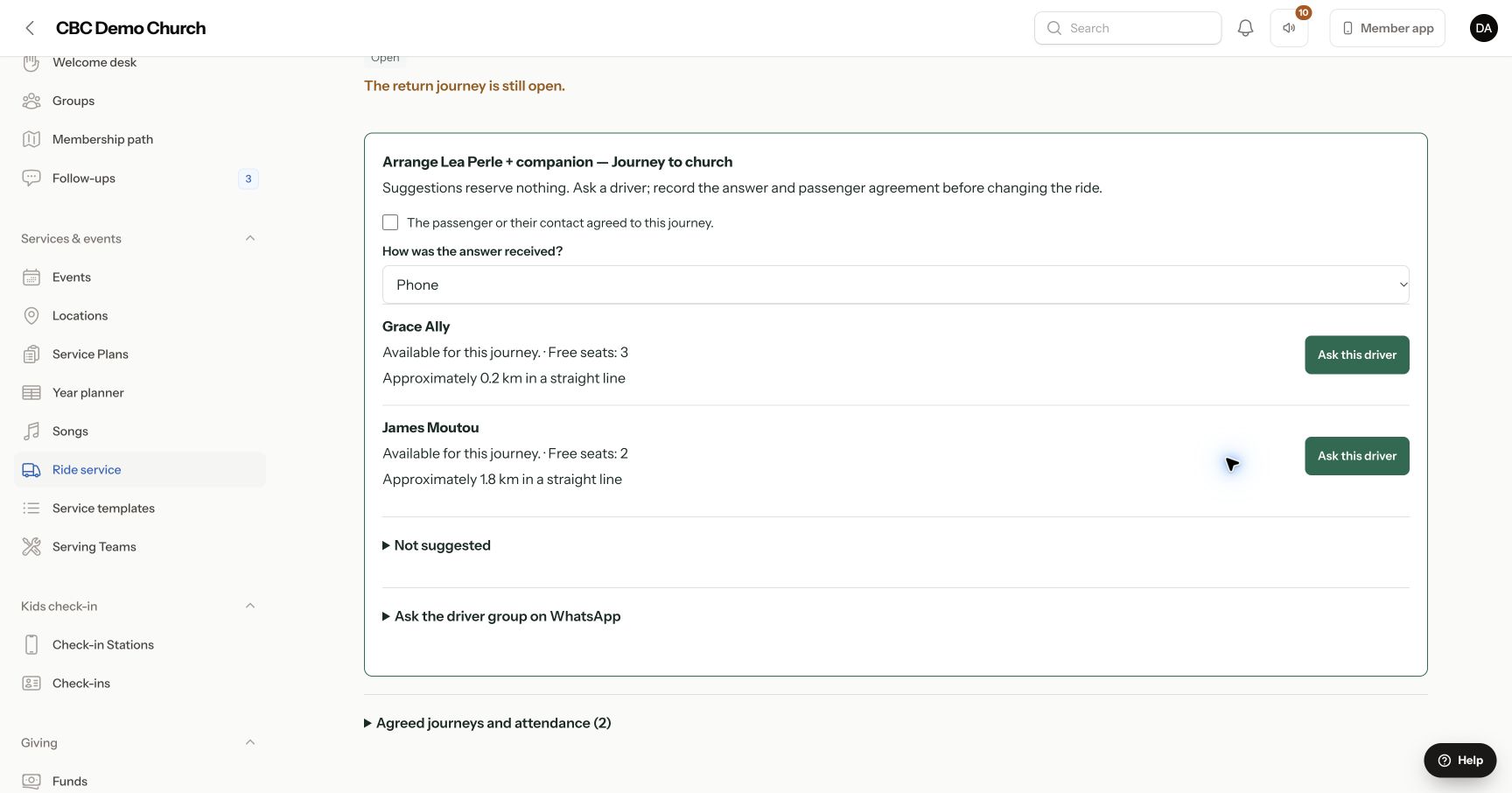
The coordinator sees who needs a ride, where they live and how many seats they need. For an open ride, CBC suggests suitable drivers. The coordinator still asks, and a new ride only counts once the driver agrees. Regular rides that are already agreed simply continue.

cbc

Ride pool

18 October · example
Schematic fictional locations: round markers show passengers and square markers show drivers. This is not a street map or a driving route. HillsideBayviewOld Mill S E D T C ML HB RA AP

Needs a rideDriver’s homeApproximate relative locations

      Fictional people and places. The schematic shows relative locations, without streets or routes. Distances are rough straight-line guides, not driving times. Suggestions never book a ride on their own.

      What goes in the pool

      Names, number of people including companions, pickup address and meeting point, journeys needed, practical help such as a walker, and a contact person.

      Drivers add where they start from, their free seats and what their car can carry. General standby help can leave dates and seats open.

      How suggestions are sorted

      First check approval, date, direction, enough seats for the whole group and a car that suits any practical help. Among suitable drivers, CBC favours familiar pairings and concrete availability before general standby readiness, then uses rough straight-line distance.

      Suggestions help with open rides and cover. Agreed rides stay with their agreed driver. General willingness is not a seat: record the standby driver’s availability and seats for that date first. A missing location still allows personal coordination.

      Who sees what

      Only the coordinator and the backup see the full list and map. A driver gets the pickup details and a Maps link only after agreeing to that ride.

      A request in the driver group says “2 people · Bayview · 9:00 · walker”, without names or addresses.

      Inside CBC

      One place to coordinate.
      Simple for everyone else.

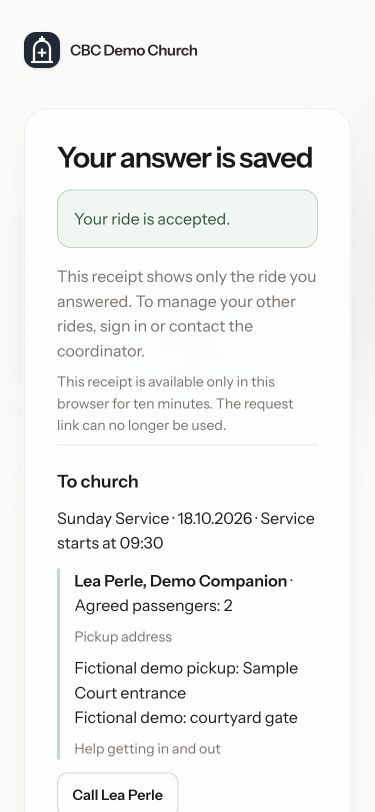
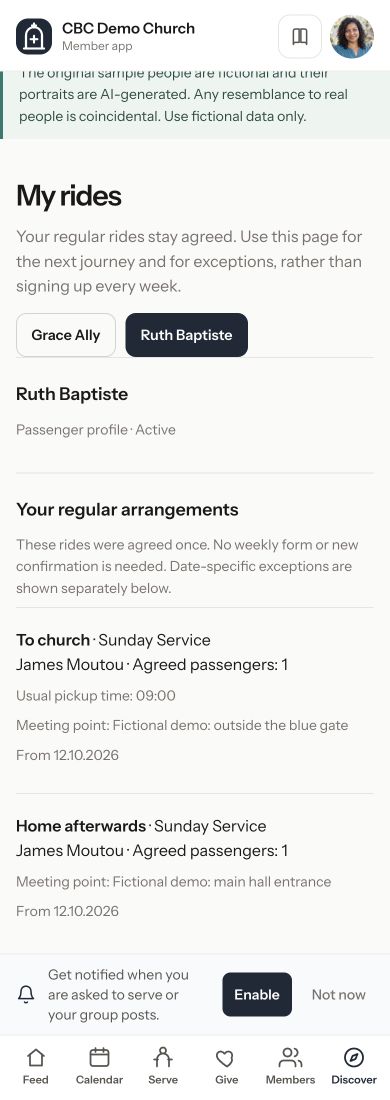
      The day plan, personal ride view and driver reply are part of CBC. These original screenshots show the public demo with fictional people and pickup details. Select a picture to see it at full size.

      Explore the real CBC demo

      The ride service is now available to explore in the CBC demo. Try the coordinator and member views with fictional examples.

      After the service

      Nobody should be left wondering how to get home.

      A clear meeting point and an agreed departure time make the return journey easier. Someone is available at church to help, with a named backup.

      • Staying for coffee? Tell the return driver or coordinator and agree the new timing.
      • Going with someone else? The new driver agrees, seats are checked, and the original driver is told.
      • Still waiting? The person stays on the coordinator’s list until a real solution is agreed.

      Drivers give a short report after their return round. An unfinished journey stays visible; a planned ride does not mean someone is home.

      Return journeys

      Meet by the church entrance · around noon

      ML
      Marie + Jean

      2 people · with Clara

      On the way
      HB
      Hugo

      Staying for coffee · agreed pickup 12:30

      Waiting

      Paul is coordinating today.
      A named backup is available if Paul cannot help.

      Fictional illustration of return coordination. The real CBC day plan keeps unfinished journeys visible.

      WhatsApp, with a clear purpose

      Ask for help.
      Keep one agreed plan.

      A small, optional driver group helps find cover. It works best when there is one person handling each request.

      Coordinator posts a request in the optional driver group. Approved drivers reply privately. The coordinator agrees one replacement, updates CBC, and informs the people affected.

      Who is in the group?

      The coordinator, backup coordinator and approved regular or standby drivers who want to receive requests.

      Seniors and relatives contact their driver or the coordinator directly. A WhatsApp account is never required to receive a ride.

      Who writes in it?

      Only the coordinators post requests. Drivers reply privately to the person managing that request. Once a ride is covered, the coordinator marks it “sorted”.

      Pickup addresses and personal details go directly to the agreed driver. Joining is voluntary; group members can see one another’s phone numbers.

      What about side arrangements?

      A delay or quick question can be handled directly. A change to the driver, people, journey or return plan must be recorded in CBC and shared with everyone affected.

      Sending a message is not a confirmed ride. The replacement must actually agree. If an urgent message gets no reply, call or speak in person.

      Start small, learn together

      Two or three Sundays.
      A supervised pilot.

      We would start with a small group, clear regular arrangements, a reachable coordinator and a backup — then see what works in real life.

      1

      Agree the local details

      Driver approval, practical assistance, contact numbers, pickup rules, return meeting point and what to do when someone does not appear.

      2

      Try the normal week and exceptions

      Use agreed rides, a driver absence, an extra passenger and a return change. Keep a current phone fallback if the app or internet is unavailable.

      3

      Check whether it helps

      Does it save coordination time? Are people entering less each week? Does everyone know their return plan? Are any passengers left waiting?

      The ride service is implemented in CBC. Our church’s pilot still needs its local coordinator, backup, approved drivers and practical arrangements. We can try a small supervised group before expanding.